ETHICS
Ethical Teachings
Our founder has been teaching ethics for over twenty years to students from many counties and cultural backgrounds. Knowing right and wrong must come from an innate sense of ethics which cannot be improvised within situational circumstances.
For this purpose he designed a workshop based learning method that enables each student to pursue a path to self understanding and development and engage in their own ethical quest.
Teachings start with a journey through many approaches of ethical philosophy, highlighting the vision of each thinker. How these approaches influence problem finding and the resolution of ethical dilemmas is then discussed. Students are prompted to examine their own conscience and respect for key values as well as for others.
The goal of these teachings is to help students develop their own ethical philosophy in accordance with their conscience so that they may make more ethical decisions in the future.
Ethical Reforms
The Valorism Institute seeks to prompt for ethical reforms in education, society, and individual consciences. We expect to take recourse whenever minor wrongs are perpetrated for no higher purpose, or when great wrongs are perpetrated for an alleged higher purpose. The all too often quoted Machiavellic response, realpolitik excuses of needing to do wrong for the right reasons, cannot be justified in any way. We must bring ethical responsibility to the forefront of our thinking and decision-making, or live in the sorry world that results.
Ethics in Education
Education must lead students to become independent thinkers who deeply consider all things before establishing what is to be believed and deciding what must be done. The main deterrent of ethical development in children and young adults is education preventing them from judging for themselves what matters and what they must do. Values are therefore necessary to reach an ethical decision.
Ethics cannot develop without seeking within oneself which questions and answers make the most sense. In the absence of your own ethical judgment, it can be understood that you would need guidance. this is because when values are learned but not fully embraced, they are of little practical use .They will seldom make their way into ethical decisions. Sweeping reforms are therefore needed in schooling to empower students to validate their beliefs and gain insight into what moves the heart and enlightens the mind.
Ethics in Individuals
When each of us reaches a decision, we impact our own life and the lives of others. We must not underestimate the power that we wield. It is most often directly felt in its effects. However, it can also be far reaching in its long term indirect consequences. A bit of humanity expressed at the right time, using intuition and benevolence, can make a greater difference than we realize. For this purpose each person can embark on a pilgrimage into their own conscience, to discover who they really are and to become whom they wish to be. Individuals, one by one, must harness their motivations and engage on the rugged trails of self-discovery. This is the cornerstone of developing an ethical way of life and responsibly administering one's own power.
Ethics in AI
There are several reasons for which ethics are blatantly absent from Artificial Intelligence. The first is the fact that AI uses mechanistic processes in its computing logics and is currently incapable of organismic thinking. The second reason is that computer hardware and software have been consistently created to solve concrete practical problems and were never designed to be capable of abstract conceptual thought. Thirdly, most of those engaged in the financing, research and development of AI have extremely limited notions of ethics and possibly no awareness or understanding of what ethics are or how to make a person, or a virtual being, ethical Designing an ethical AI will require creating an entirely different general intelligence architecture associating organismic to mechanistic logics and ensuring that values systems are operative so that ethical values can be present and empowered..
Ethics in Society
Society should transmit values understood and appreciated for their intelligence and shared by all members of the community. Institutions and organizations need to embody values that offer to their members a belonging that reaches beyond practical goals. The ethics of society and of its organizations are the most vital of all our values. They are those with the most fundamental of impacts. To unify a people and forge the bonds of a group, ethics cannot be neglected.. A society is accepted and endorsed according to its perceived ethical validity.
Ethics in the Arts
We can not that art is no different from other fields of endeavor and has its fair share of both ethical and unethical individuals. However, as elsewhere it can be noted that where there is power and money people's behavior can change and also such realms attract people who seek to gain advantage at other' expense. In the art world there have been many anecdotes about the unethical behavior of artists themselves, throughout history. From philandering and jealousies to profiting from other's misfortunes, this paints a rather sad picture of morality in the arts. Given the wealth that is at times invested in culture, the arts attract clusters of profiteers of every nature. Hence there are many accounts of merchants robbing artists, auctioneers misrepresenting works, experts authenticating works, whether real or fakes, against payment. And as elsewhere, there is little legislation in these matters than can't by skillfully bypassed by networks of professionals working together in collusion.
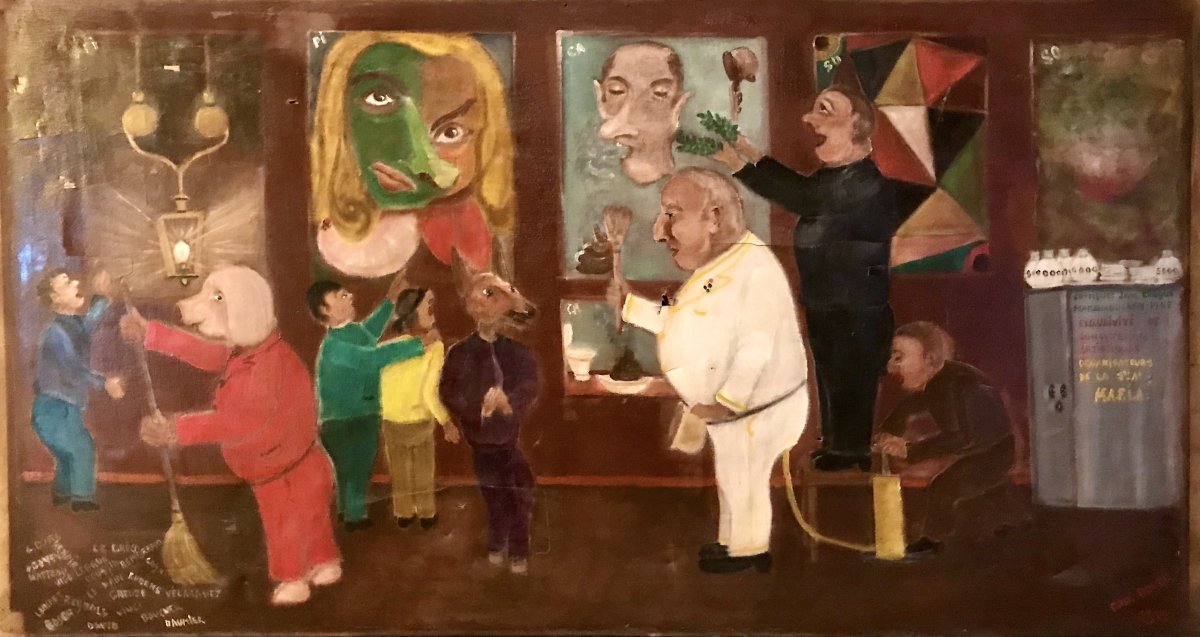
Art Manipulated by NETWORKS
Mercantilism in Art
This painting dated 1971 by Paul Boyer illustrates the many idiosyncrasies of art merchants. The Valorism Institute joins this artist in denouncing the rampant corruption and generalized dishonesty of art merchants and cabals of experts. Parties may use whatever knowledge and influence they possess to further special interests without regards for art, the artists themselves, art amateurs and collectors, and victimized art purchasers. Titled PiPi CACA SOSO as initialed in the backdrop of six paintings. using a play on words on Picasso's name having become a marketed brand more than a justified reputation, This highly politicized artwork refers describes his works by his name's syllables 'with a stutter' as Pipi, Caca and So-so.. Pablo Picasso paints with a toilet brush while a merchant inflates his ego with an air pump while kneeling before his well garnished safe. To the left a pig sweeps away the names of the great masters of the previous centuries. For its revelation of the unethical practices of the art world, this work is conserved in our collections.
The Art Market Confronted
The Valorism Institute founder confronted the French Minister of Culture at a public event held at the Culture Ministry in 2006, to discuss the future of the international art market. Before an audience of journalists and the cultural community the Minister was formally requested to take strong initiatives for ethical regulation of the art market.
Regrettably, he evaded this call for action and at the ensuing reception the founder was quickly approached by a leading French auctioneer. His quest for ethical reform was met by an attempt to bribe him into silence by offering to sell to him at ridiculously low prices any major works of art he wished. All he needed to do was ask. Of course they failed in their attempt to silence us, and again we call for an end to such rampant corruption.
Sadly, this illustrates pervasive wrongdoing in the international art scene. Further evidence of unethical manipulation of the art market was later revealed by the actions of certain museum directors, their staff, boards of artist catalogs, and qualified experts sometimes at the service of merchant networks.